
News
20% power consumption reduction with separation membranes. Tsubame BHB begins development of an energy-saving ammonia manufacturing process.
- Publish :
- 28 Jun 2023
Tsubame BHB Co., Ltd. (Head Office: Chuo-ku, Tokyo; CEO: Masahiro Watanabe; “Tsubame BHB”) has confirmed that by introducing membranes in the company’s ammonia manufacturing process, it is possible to reduce the electric power required for manufacturing by about 20%, and to separate high concentration ammonia.
Recently, using the company’s test facilities, Tsubame BHB evaluated the performance of membranes provided by Mitsubishi Chemical Group under conditions expected with actual ammonia manufacturing equipment. These tests confirmed separation performance exceeding initial expectations, with an ammonia concentration of 95% or more in gases that permeated the membrane.
Estimates when membranes are introduced into Tsubame BHB’s ammonia manufacturing processes
- Electric power required for ammonia manufacturing (excluding hydrogen manufacturing) is reduced by approximately 20%
- When using electric power from fossil fuels, CO2 emissions from ammonia manufacturing are reduced by approximately 20%
- When using renewable energy, ammonia production volumes achieved using the same electric power volumes are increased by approximately 25%
 Comparison of power consumption in ammonia manufacturing
The ammonia synthesis reaction is an equilibrium reaction, and exhaust gases from the reactors contain large quantities of unreacted nitrogen and hydrogen, making it necessary to recycle large volumes of unreacted gases. To separate ammonia from mixed gases, in existing processes, the mixed gases are cooled using refrigerators to concentrate and separate the ammonia. By separating ammonia from the mixed gases using a membrane, it is possible to separate high concentration ammonia. In the membrane process, refrigerators are not required, so power consumption can be reduced.
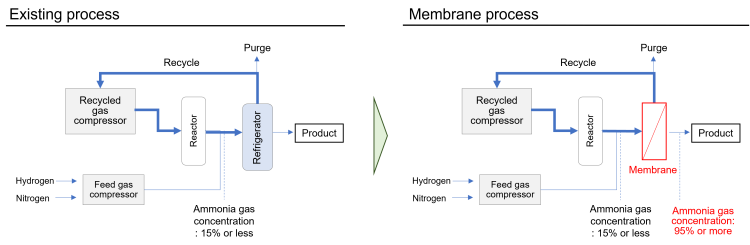 Ammonia manufacturing process using membranes